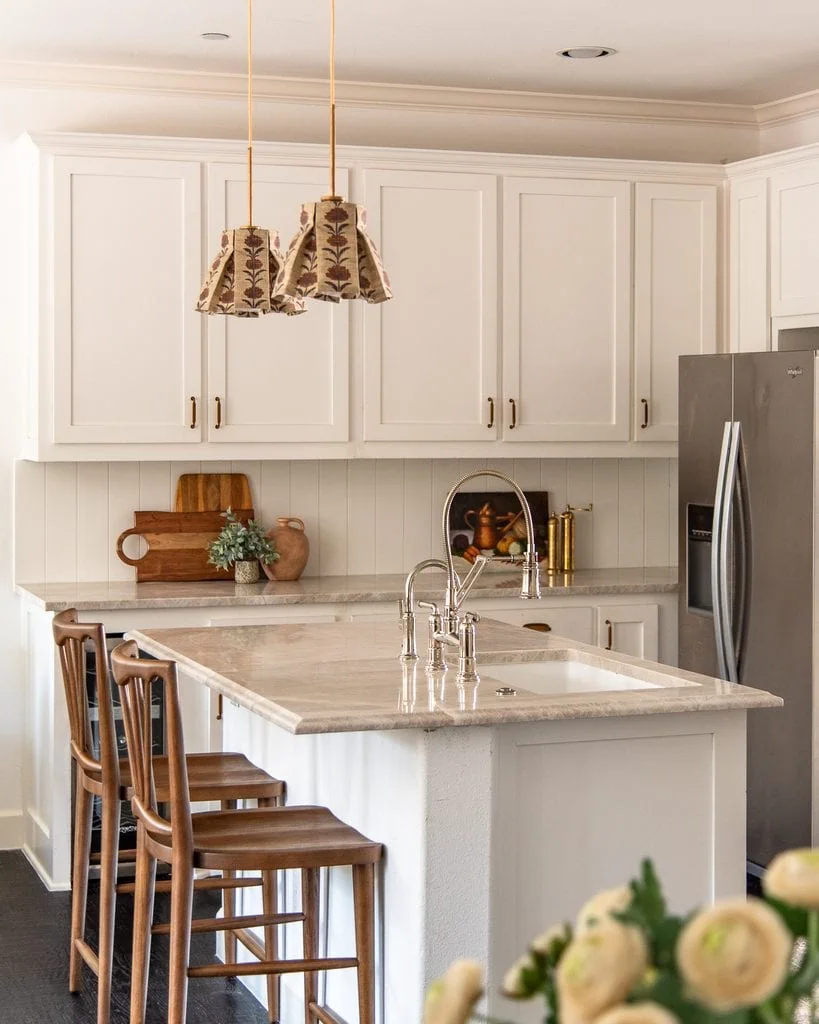
We replaced the black granite in our small, low-light kitchen with polished Taj Mahal quartzite, and I would absolutely choose it again. I absolutely love it! The creamy natural stone immediately made our kitchen feel brighter, softer, and more elevated without introducing the cool gray veining I was trying to avoid.
That said, choosing Taj Mahal was not as simple as asking for the stone by name. I went back and forth between multiple slabs and finishes before selecting the simplest, creamiest, quietest slab I could find. That decision ended up being especially important in our smaller kitchen, where a busier or more caramel-colored slab could have felt much heavier.
Here I’ll give an honest review of Taj Mahal quartzite, share photos of our project, discuss cost, cabinet colors, and interior design tips for styling a Taj Mahal quartzite kitchen. Let’s get to it!
Taj Mahal Quartzite Kitchen: Key Takeaways
- Would I choose it again? Absolutely. It brightened our small kitchen while still relating beautifully to our very dark wood floors and other warm finishes.
- What did our Taj Mahal quartzite kitchen cost? The countertop portion totaled $5,405. Our full documented update totaled $8,816.61 before miscellaneous backsplash and wall-repair supplies.
- What color is Taj Mahal quartzite? It is generally a warm cream, ivory, or oatmeal stone with taupe, beige, soft gold, and sometimes gray or mauve-looking movement. Every slab is different.
- My biggest selection tip: Inspect the exact full slab and tell the fabricator which areas to feature or avoid. Our stone has a filled imperfection I wish I had caught during layout.
- Best design advice: Do not match every finish to the same mid-tone beige. Taj Mahal needs enough light-and-dark contrast to keep a kitchen from looking flat.
What Is Taj Mahal Quartzite?
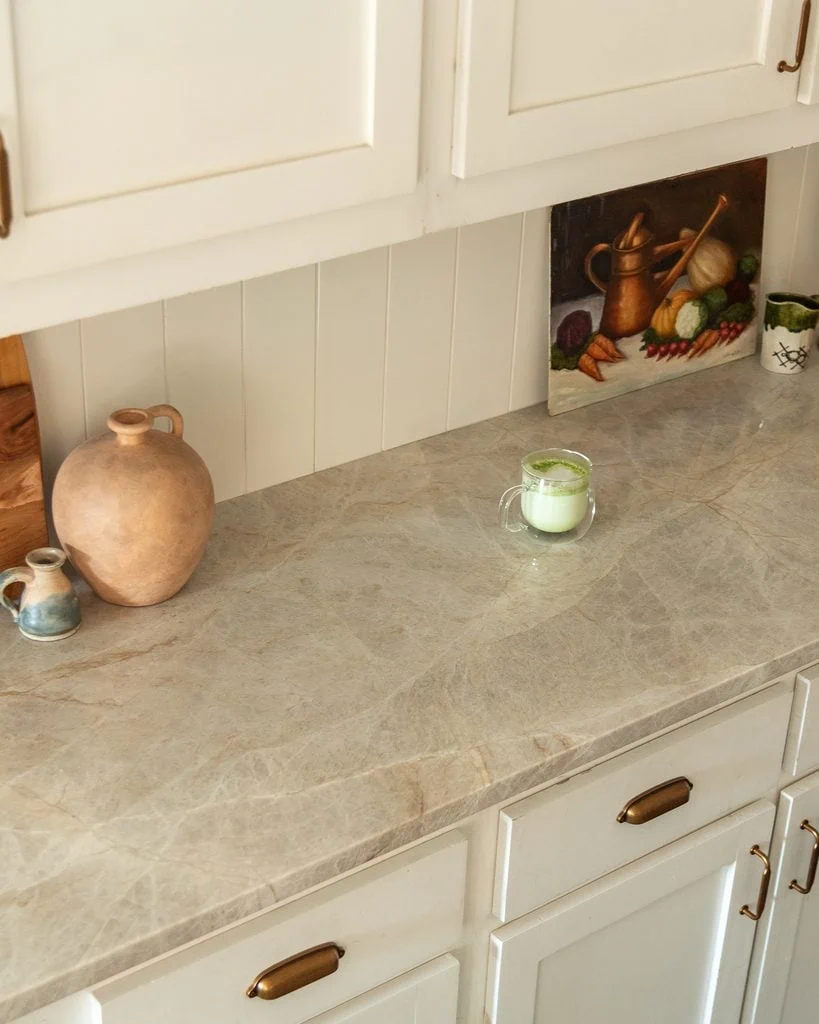
Taj Mahal quartzite is a natural stone known for its warm cream background and soft, flowing beige, taupe, and gold movement. It gives you some of the depth and variation people love about marble in a generally harder, more scratch-resistant material. Unlike engineered quartz, it is quarried from the earth, so no two slabs are exactly the same.
The natural variation is both the beauty of Taj Mahal and the reason I would never order it from a tiny sample. “Taj Mahal” describes a family of slabs, not one perfectly consistent manufactured pattern. One slab can look pale and crystalline, another can be strongly caramel, and another can contain wider or more dramatic bands of movement.
Though slabs differ a lot visually, they should hold up to wear and tear the same. As long as it is truly Taj Mahal quartzite, the Natural Stone Institute’s quartzite guide says that true quartzite should resist scratching and ordinary kitchen acids better than marble.
What Color Is Taj Mahal Quartzite?
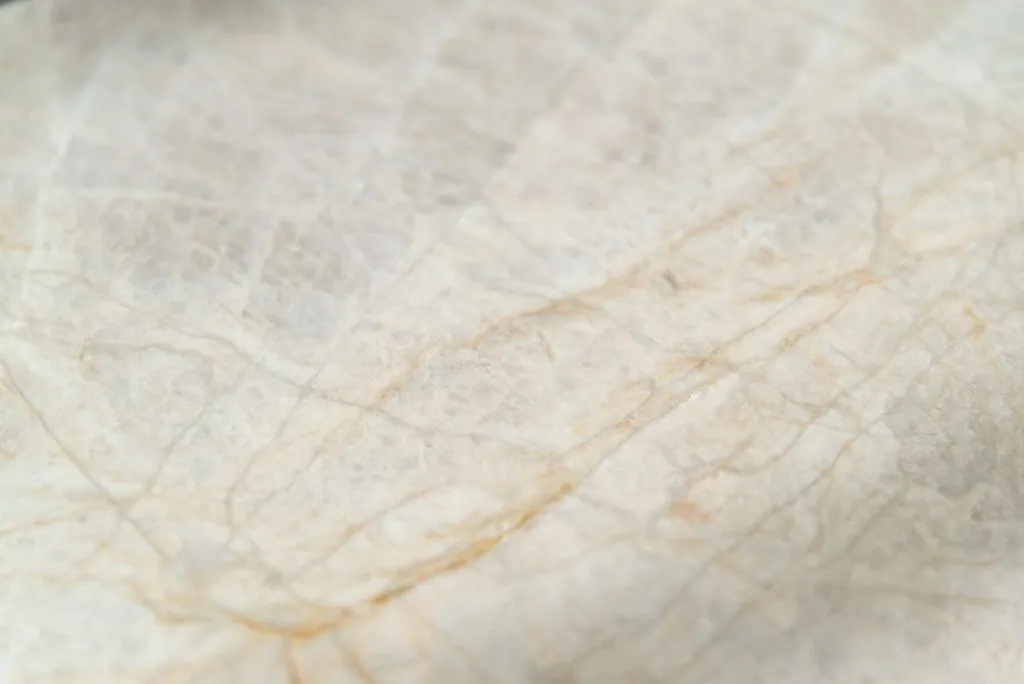
Taj Mahal quartzite is usually a warm cream, ivory, linen, or oatmeal color with movement that can include taupe, beige, caramel, soft gold, gray, and even faint mauve or violet shadows. The exact color depends on the slab, finish, lighting, and surrounding materials.
Our slab is much closer to creamy linen than yellow beige. From a distance, it creates a soft, quiet field of color. Up close, it has delicate crystalline areas and taupe-gold movement that give it depth without dominating the room.
How Our Taj Mahal Quartzite Changes in Different Light
This was one of the biggest surprises for me: Taj Mahal is not always visually warm in the same way. Our kitchen gets limited natural light. It receives indirect eastern light through our living and dining room and warmer western light from one recessed hallway window later in the day.
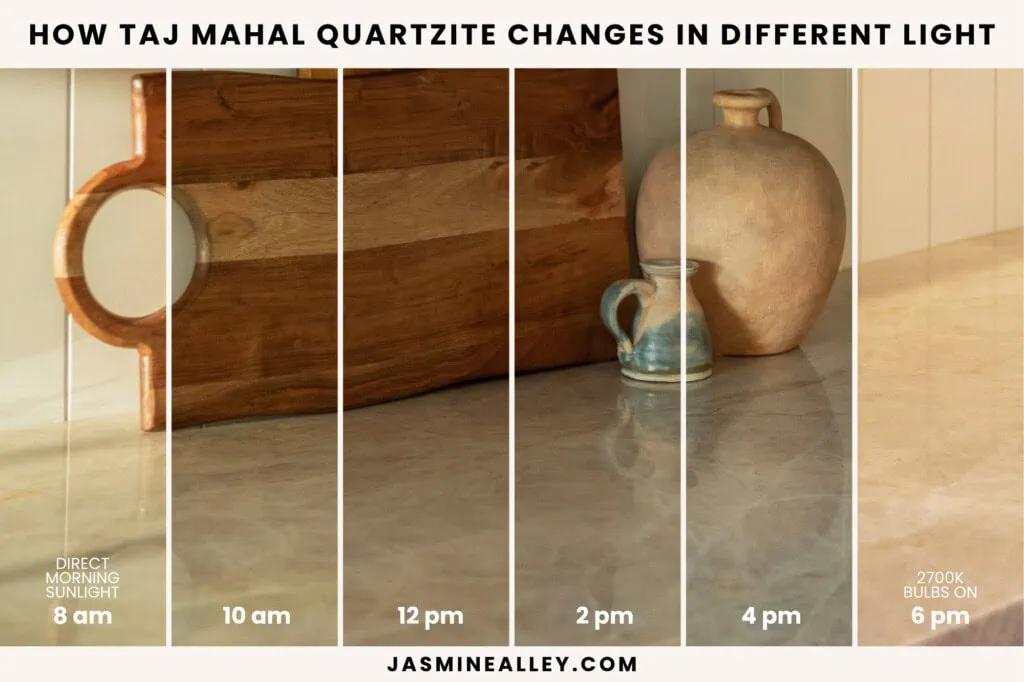
In cool indirect light, parts of our slab can cast a subtle violet or mauve-gray shadow. In warmer morning light and under our 2700K bulbs, it looks creamier, softer, and slightly more golden. The surrounding light is changing which undertones become most visible.
This is why online photos can be misleading. A phone may correct the white balance, showroom lighting can exaggerate warmth, and a polished surface reflects the colors around it. If you are choosing a slab, photograph it from several angles, but trust what your eyes see in person more than the image on your phone.
How I Chose Our Taj Mahal Quartzite Slab
I didn’t walk into the slab yard, point to the first Taj Mahal label, and call it a day. Rather, I compared several natural stones, different Taj Mahal slabs, and different finishes. I wanted warmth, but I didn’t want a countertop that looked yellow, brown, strongly linear, overly gray, or visually busy. I visited the slab yard 2-3 times before landing on my decision.
Here are six different slabs I photographed at Cowboy Countertops. Can you tell which one is mine?
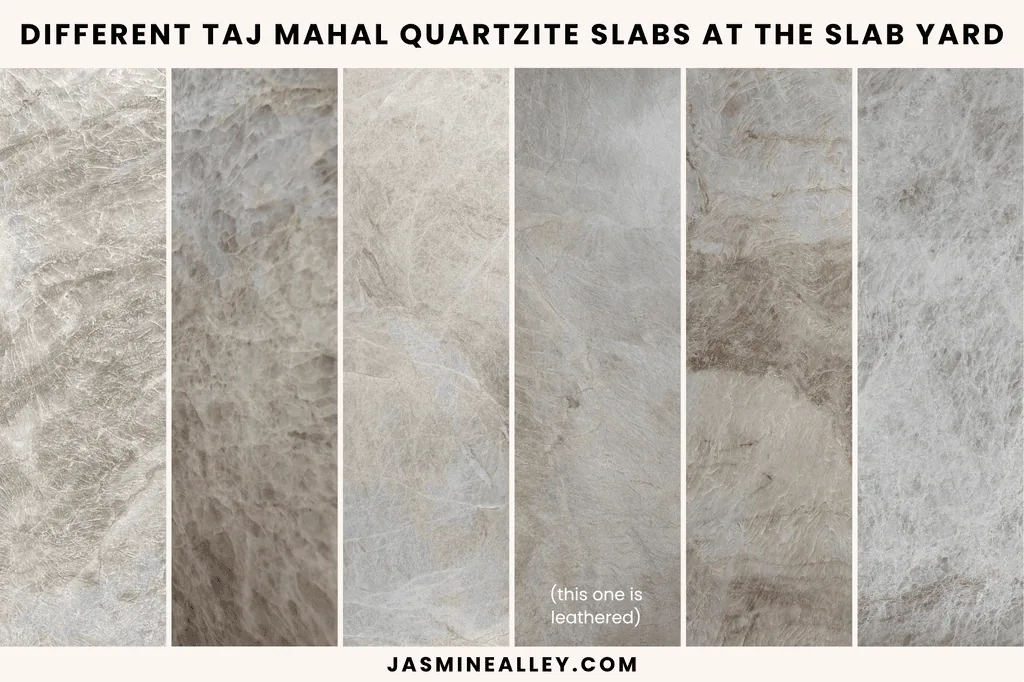
Answer: Mine is the 3rd one! And I almost chose the first one, until I realized that for my kitchen in particular, my ideal slab had:
- A creamy linen or oatmeal background
- Soft taupe and gold movement rather than harsh gray veins
- Enough variation to look unmistakably natural
- No single dramatic vein that would control the entire kitchen
- A lighter overall value that would counterbalance our dark floors
- A pattern quiet enough for our smaller room
- As little gray as humanly possible (I nixed the 6th slab very quickly for that reason!)
Looking back, choosing the right slab was probably the most important decision in the entire project. Cabinet paint can be changed later. Hardware can be replaced. A fabricated natural-stone countertop is far more permanent and expensive to redo!
My Creamy Slab vs. a More Caramel Taj Mahal Slab
I narrowed my decision to two Taj Mahal slabs that looked surprisingly different. One was lighter, quieter, more linen-colored, and more crystalline. The other had noticeably more caramel warmth and stronger movement.
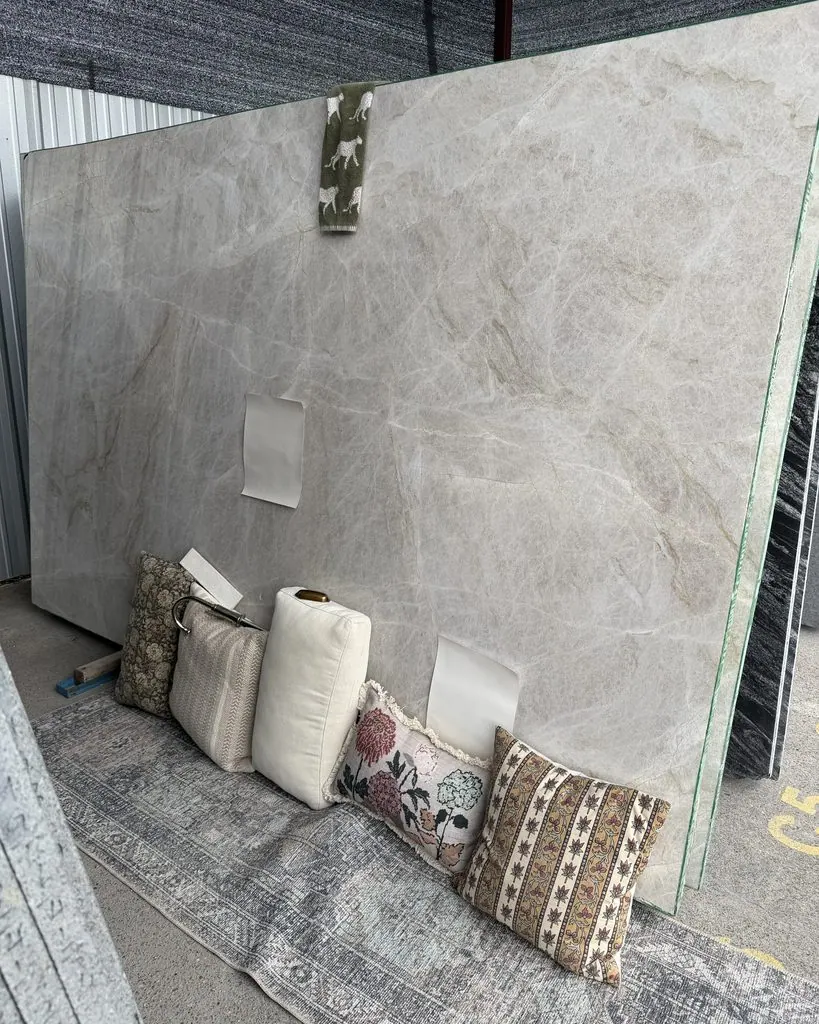
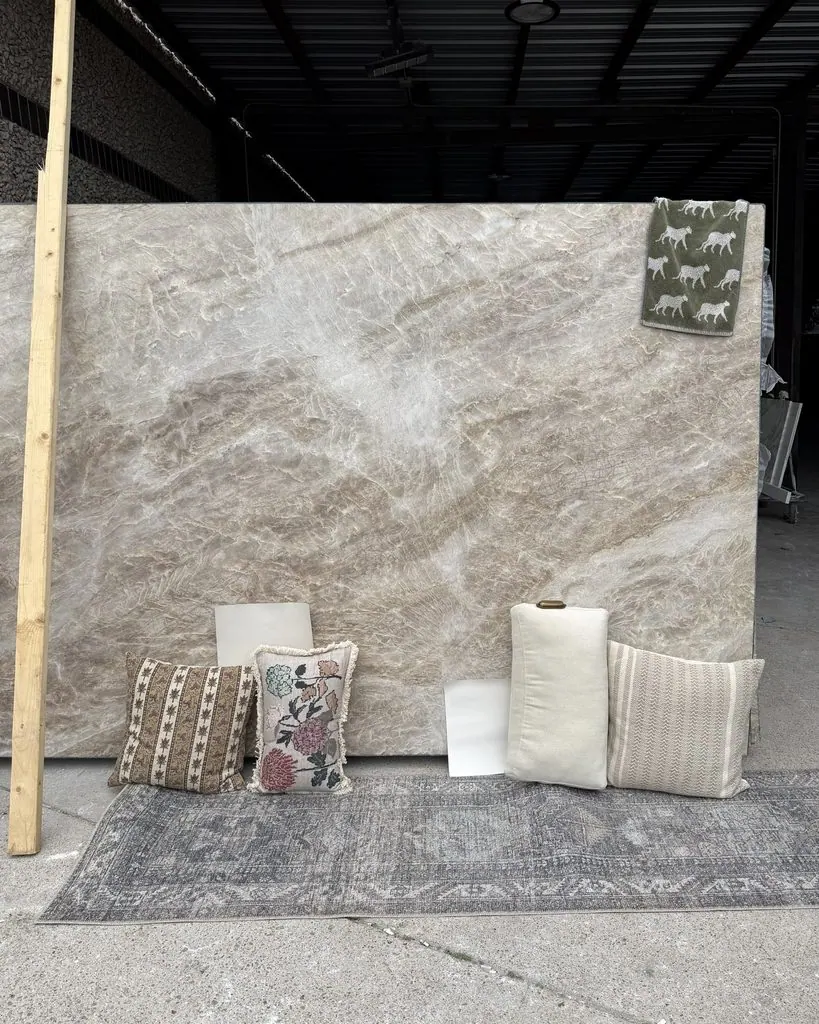
I went back and forth because the warmer slab was beautiful on its own. But a slab doesn’t live at the stone yard—it has to live in your actual room. I brought some of my kitchen, dining room, and living room textiles since we live in an open floor plan (see my home tour here!), and put them in front of each slab to see how the colors worked together.
What I wasn’t able to bring to the slab yard is the fact that we have a relatively small kitchen, very dark hardwood floors, and limited natural light. I realized the more caramel slab would add another visually heavy mid-tone, while the quieter creamy slab would reflect more light and give the room room to breathe.
I chose the simplest, creamiest slab, and I’m so glad I did. It still has natural movement and character, but it does not make our kitchen feel smaller. It almost acts like a polished yet velvety linen in our space! So if your kitchen is compact or dark, I would pay just as much attention to the overall color value and density of a slab as its individual veins.
(Not sure what colors would look best in your kitchen? Read about the 60-30-10 color rule in interior design here!)
My Taj Mahal Quartzite Slab Selection Checklist
- View the full slab. A small sample cannot show the scale, direction, or concentration of the movement.
- Step at least 8–10 feet away. Close-up details matter, but the slab’s overall visual weight is what you will experience across the room.
- Look for repairs, fills, fissures, pits, and resin. Natural variation is expected, but you still need to know exactly what you are buying.
- Ask whether all slabs are from the same bundle. If your kitchen needs more than one slab, the slabs should coordinate.
- Bring samples from your room. Cabinet doors, paint samples, flooring, backsplash, and metal finishes can reveal undertone conflicts.
- Discuss the template and vein placement. Ask which portion will become the island and where seams, sink cutouts, and focal veins will land.
- Mark areas you want to feature or avoid. Do not assume the fabricator knows which natural markings bother you.
- Confirm the finish and edge in writing. I wish I’d drawn out my ogee edge in person rather than assuming my fabricator could understand what I meant by my explanation! (More on that in just a bit.)
Our Taj Mahal Quartzite Kitchen Before and After
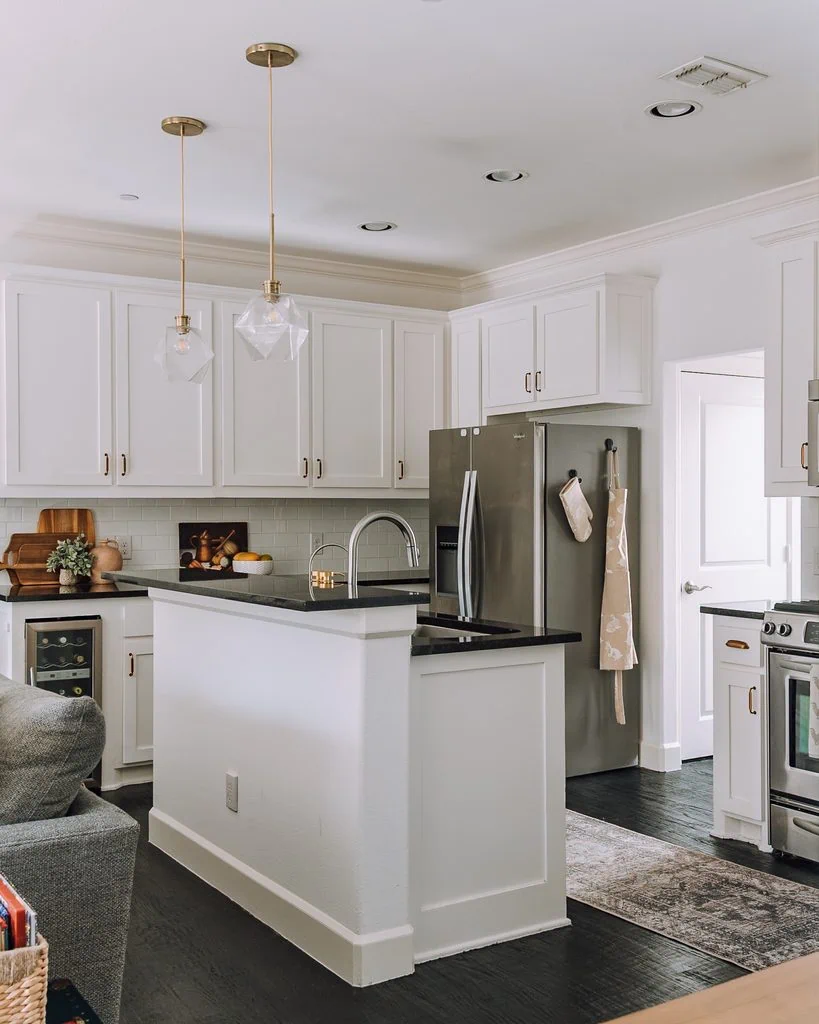
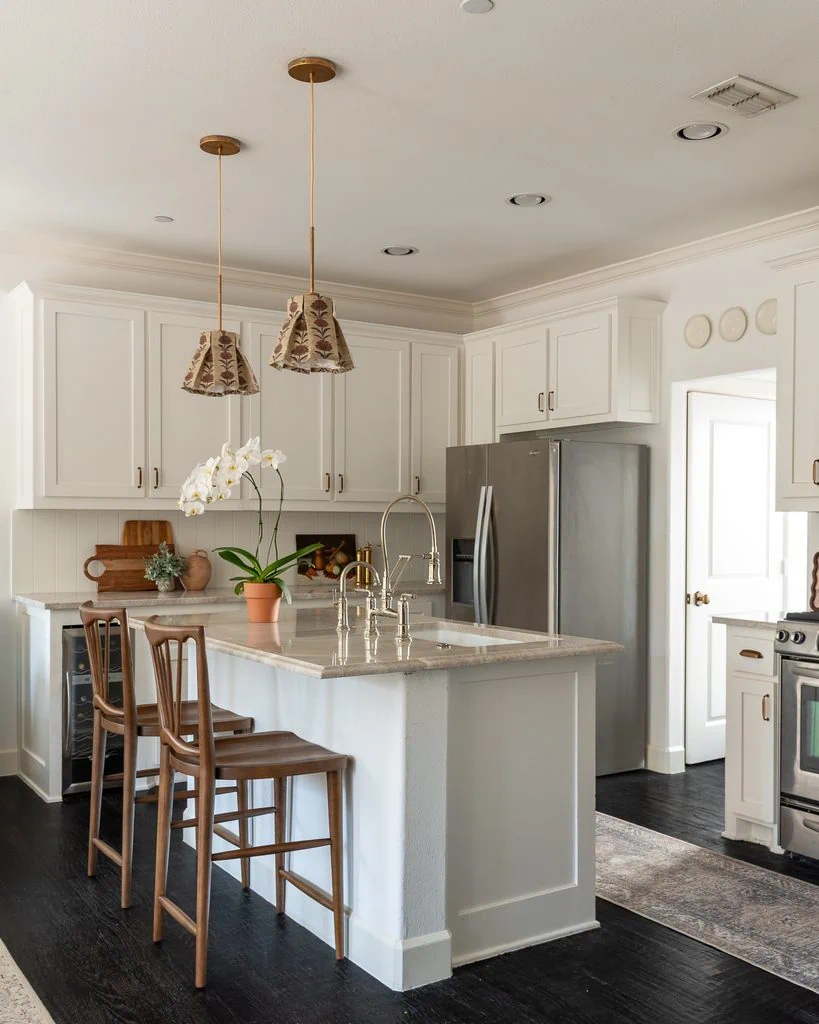
Note: The before and after photos were taken at different times of day and during different seasons, so the after photo has naturally warmer light. Some of the visible difference comes from the shooting conditions, but the Taj Mahal quartzite and updated finishes also made the kitchen feel noticeably warmer in person.
It’s night and day! I’m so thrilled with the results!
Before this project, our kitchen had black granite countertops, white cabinets, white subway tile, and a raised two-tier island. The granite was functional, but visually it created a very dark horizontal mass in the middle of an already low-light kitchen.
Dark materials are not automatically wrong, but color has visual weight. In our room, the black counters absorbed light and strongly divided the white upper cabinetry from the dark wood floors. The kitchen felt more compressed and heavier than I wanted.
Taj Mahal solved that without pushing the kitchen into cold, stark-white territory. Its lighter value reflects more light, while the cream and taupe undertones still connect to the warmth of our floors. This project was a very practical example of a principle I discuss in my guide to using color theory in interior design: the value, temperature, and visual weight of a material matter just as much as its named color.
Now the kitchen is warmed by our wood counter stools, using a warmer metal (polished nickel) on the faucets, and warmer pendant lights. (I used Rub n Buff on the pendant lights to make them a warmer antique brass color and made fabric pendant shades to replace the glass pendants.)
Leveling Our Raised Kitchen Island
We also paid our handyman $600 to level the island. Removing the raised bar made a huge difference. The new single-level surface is approximately 67.5 inches by 43.5 inches with an 11-inch seating overhang, so it now reads as one generous work surface instead of two smaller, interrupted levels.
The simpler silhouette also lets the Taj Mahal quartzite become the focal material. It is easier to see the movement across the slab, and the continuous surface makes the kitchen feel wider and calmer.
How Much Does Taj Mahal Quartzite Cost?

With a small kitchen, we only needed to choose one slab. Our Taj Mahal quartzite kitchen countertops cost $5,405 for the stone, fabrication, installation, sink cutout, old-counter demolition, and upgraded ogee edge. The full collection of documented costs for this phase of our kitchen update was $8,816.61, excluding miscellaneous construction adhesive and wall-repair supplies.
Here is exactly what we paid:
| Item | Cost | What It Included |
|---|---|---|
| Taj Mahal quartzite | $4,280.00 | Material, fabrication, installation, and sink cutout |
| Existing countertop demolition | $650.00 | Removal and disposal of the old black granite |
| Ogee island edge | $475.00 | Decorative edge on the island only |
| Countertop scope subtotal | $5,405.00 | Stone-related work |
| Leveling the island | $600.00 | Handyman labor to remove the raised bar and create one level |
| Old backsplash demolition | $150.00 | Handyman labor |
| HOROW fireclay sink | $286.86 | Sink, bottom grid, and strainer |
| Polished-nickel plumbing fixtures | $2,337.27 | Bridge faucet, beverage faucet, air switch, drain, and tax |
| DIY backsplash material | $37.48 | One sheet cut into horizontal pieces |
| Documented project total | $8,816.61 | Before miscellaneous adhesive and wall-repair supplies |
One money-saving decision was hiring our handyman to remove the old backsplash. He charged $150. The countertop company quoted $434 for backsplash demolition, plus another $250 to replace damaged drywall. (Tip: Because demolition often damages the wall behind a backsplash, ask whether drywall repair is included before comparing quotes.)
We have many friends who work in remodeling and construction; they’ve told me that prices vary by location, slab size, number of slabs, fabrication complexity, edge profile, cutouts, seams, access, and demolition. So when requesting a quote, ask for every line item! A low material price is not useful if fabrication, installation, removal, edge upgrades, or cutouts appear later.
How We Saved Money on Taj Mahal Quartzite in Dallas
We used Cowboy’s Countertops here in Dallas (not sponsored!!), and their pricing was one of the biggest reasons this project came in lower than I expected. We paid $4,280 for the Taj Mahal quartzite itself, fabrication, installation, and our sink cutout. When we were shopping, multiple people told us that purchasing a Taj Mahal slab through one of the larger stone suppliers or slab yards in Dallas could cost around $8,000 or more for the slab alone—before fabrication and installation.
A slab yard or stone supplier typically imports and displays the stone, while a fabricator templates your kitchen, cuts the slab, creates the edge profiles and cutouts, and installs the finished countertops. Depending on the company, you may purchase the slab separately and then pay a fabricator, or receive one combined quote covering everything. Cowboy’s Countertops maintains its own warehouse and handled our material and fabrication together, which appears to have helped us avoid some of the additional markup.
When comparing Taj Mahal quartzite quotes, make sure you are comparing the same scope. Ask whether the price includes the full slab, templating, fabrication, installation, seams, sink and faucet cutouts, edge profiles, delivery, and tax. Our $4,280 quote included much more than a slab-only price, which is why I consider it such a good deal.
Our Ogee Island and Eased Perimeter Edges


We chose a softened ogee edge for the island and a simple eased edge for the perimeter. The ogee upgrade cost $475, and I think it was worth it.
At first, it was such a difference when they brought it in that I was nervous I’d made the wrong decision. But after I styled it, I realized it was perfect for our kitchen! I actually had wanted slightly less of a dramatic ogee, but still love the end result. If I could do it again, I’d be sure to specify a corner radius around 1/2 to 3/4 inch.
An ogee edge adds a more traditional, furniture-like detail, but using it on every countertop could have made our smaller kitchen feel overly formal or visually busy. Limiting it to the island created hierarchy: the island is the feature, while the perimeter quietly supports it.
Polished vs. Honed vs. Leathered Taj Mahal Quartzite

Polished Taj Mahal quartzite has the most reflective, saturated appearance. Honed Taj Mahal has a softer matte look. And leathered Taj Mahal has a tactile, textured finish. I was wavering between leathered and polished. Ultimately, I selected polished because I loved the depth of our creamy slab and how it would reflect the most light in our darker kitchen.
| Finish | How It Looks | Design Consideration |
|---|---|---|
| Polished | Smooth, reflective, and richer in color | Reflects light beautifully and feels dressier; reflections and smudges can be more visible |
| Honed | Soft, muted, and low sheen | Creates a quiet, chalkier look; ask how the finish affects maintenance and stain visibility on the exact slab |
| Leathered | Textured, organic, and often visually deeper | Adds tactile character; texture can affect cleaning and make the same slab read darker or busier |
Interestingly enough, when I was first at the stone yard, I had my heart set on leathered. It fit the Amber Lewis-esque vibe I loved. But after viewing them in the stone yard, the leathered one reminded me of laminate flooring, and made me have second thoughts, especially in my low-light kitchen.
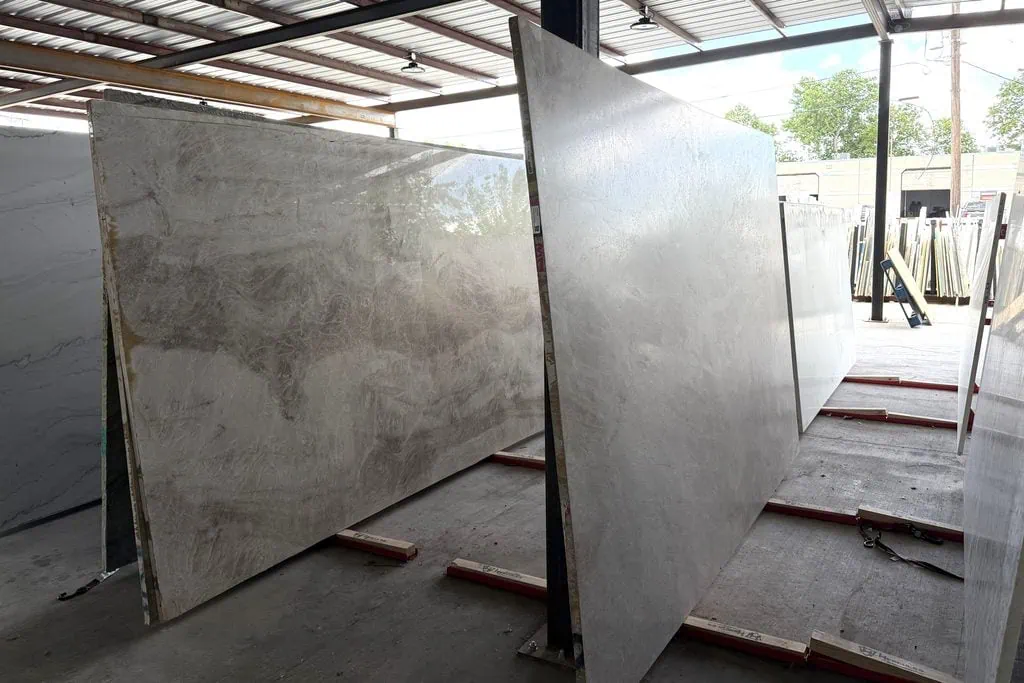
But don’t let that deter you! Lighting affects how slabs appear, and each slab is so different. Finish can affect how color, fills, surface marks, and natural texture appear. And leathered is technically more forgiving when it comes to hiding scratches (on the off chance yours gets scratched!).
What Color Cabinets Go With Taj Mahal Quartzite?

The best cabinet colors for Taj Mahal quartzite are usually warm whites, creams, putties, taupes, muted earthy greens, warm wood tones, or intentionally dark contrasting colors. The right choice depends on the undertones and overall value of your exact slab—not simply the name “Taj Mahal.”
The most common design mistake is trying to match the cabinets exactly to the stone. When the countertops, cabinets, and backsplash are all nearly the same mid-tone cream or beige, the kitchen can become flat and muddy. Harmony is good; total sameness is not. You need enough value contrast, material contrast, or color contrast to distinguish each surface. (Read my color theory in interior design guide for more on this topic!)
Warm White and Cream Cabinets
Warm white is one of the safest pairings because it lets the stone remain the warmer, more dimensional surface. Avoid assuming that every white will work. A stark blue-white cabinet can make a creamy Taj Mahal slab look dirtier or more yellow by comparison.
Our cabinets are currently white, and the contrast makes the new countertops look noticeably warmer than they did at the slab yard. That is simultaneous contrast in action: the colors surrounding a material change how we perceive it.
Putty, Mushroom, Greige, and Taupe Cabinets
These can create a warm, collected kitchen, but they require more careful sampling. Choose a color that relates to the stone without disappearing into it. If your slab is medium-toned, either go substantially lighter or intentionally deeper with the cabinetry.
I’ve seen Sherwin-Williams Accessible Beige at 50% paired with Taj Mahal quartzite on a friend’s kitchen and it looks great!
Green Cabinets
Muted olive, sage, gray-green, and muddy historic greens can all look beautiful with Taj Mahal. The green does not need to be literally present in the countertop. It works because an earthy green provides restrained color contrast while still sharing the stone’s natural, softened quality. My sister-in-law has a beautiful green paired with Taj Mahal in her bathroom.
(While we’re talking more saturated colors, my cousin-in-law has a pale blue in her Taj Mahal quartzite kitchen, which her interior designer chose! So blue is a valid option too!)
Wood Cabinets
White oak is popular with Taj Mahal, but it is not the only wood option. Medium oak, walnut, and other warm woods can work if their orange, red, yellow, or gray undertones do not fight the slab. Bring an actual door sample to the stone rather than selecting wood from a screen.
Dark Cabinets
Deep brown, charcoal, muted navy, and near-black cabinets create striking contrast with Taj Mahal. In a bright or large kitchen, that can feel dramatic and sophisticated. In our small, relatively dark kitchen, I was specifically trying to remove visual heaviness, so using a dark color everywhere would work against the goal.
The Cabinet Colors I’m Testing
I have not painted our cabinets yet, so I will update this post with the finished result once I do. But my most likely course of action is Sherwin-Williams White Duck. I tested it both at full strength and at 75%. I love how it creates a warmer relationship with the countertop than the current builder-grade white.
For the island, I have explored deeper putty and taupe colors including Sherwin-Williams Shiitake, Loggia, and Chocolate Powder and believe I’ve landed on Sherwin-Williams Sand Trap.
The goal is not to find a paint chip that “matches” one vein. It is to create enough contrast for the creamy slab to remain distinct while connecting the kitchen to our dark floors and the rest of our warm, layered home.
What Backsplash Goes With Taj Mahal Quartzite?

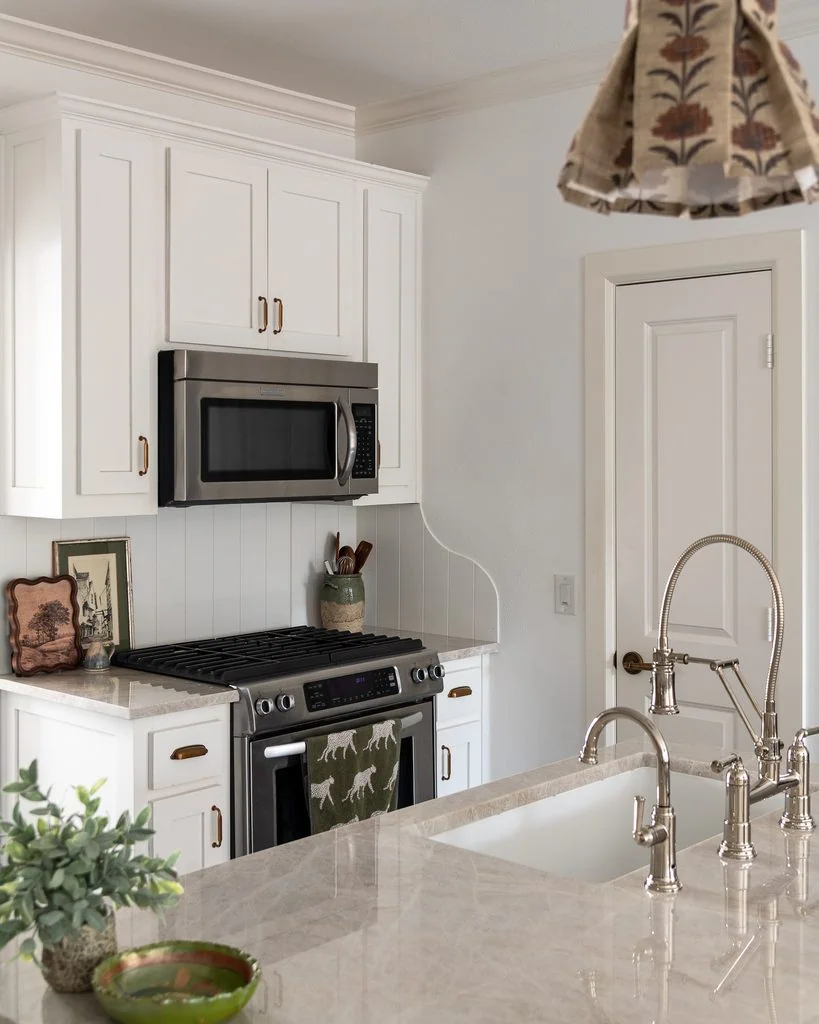
The best backsplash for Taj Mahal quartzite is usually a quiet tonal material that supports the countertop without introducing competing veining. Good options include simple subway tile, handmade-look tile, restrained zellige, plaster, vertical paneling, or a full-height slab.
In our kitchen, I chose an extremely inexpensive DIY vertical nickel-gap-style backsplash. The sheet material itself cost only $37.48, and I cut it into narrow pieces. There were additional small costs for construction adhesive and repairing the wall, but it was still dramatically less expensive than tile.
If I had wanted to carry the Taj Mahal up the backsplash, I was quoted an extra $2720 for material and labor. I absolutely love the look of a matching slab as the backsplash, but it wasn’t in our budget.
However, with the collected English country vibe I’m leaning towards, the tongue-and-groove look is classic! I plan to paint it to match our cabinets eventually. The vertical lines add subtle architecture while the solid paint color allows the Taj Mahal to remain the only stone pattern in the room.
Backsplash Colors and Patterns I Would Avoid
- Stark blue-white tile that makes the countertop look unexpectedly yellow
- Cool gray grout that creates a grid unrelated to the warm stone
- A second strongly veined material competing with the Taj Mahal
- An almost-but-not-quite beige match that flattens the entire palette
A backsplash can be simple without being boring. Texture, sheen, scale, installation pattern, and grout all provide interest without adding another competing color story.
Styling Our Taj Mahal Quartzite Kitchen
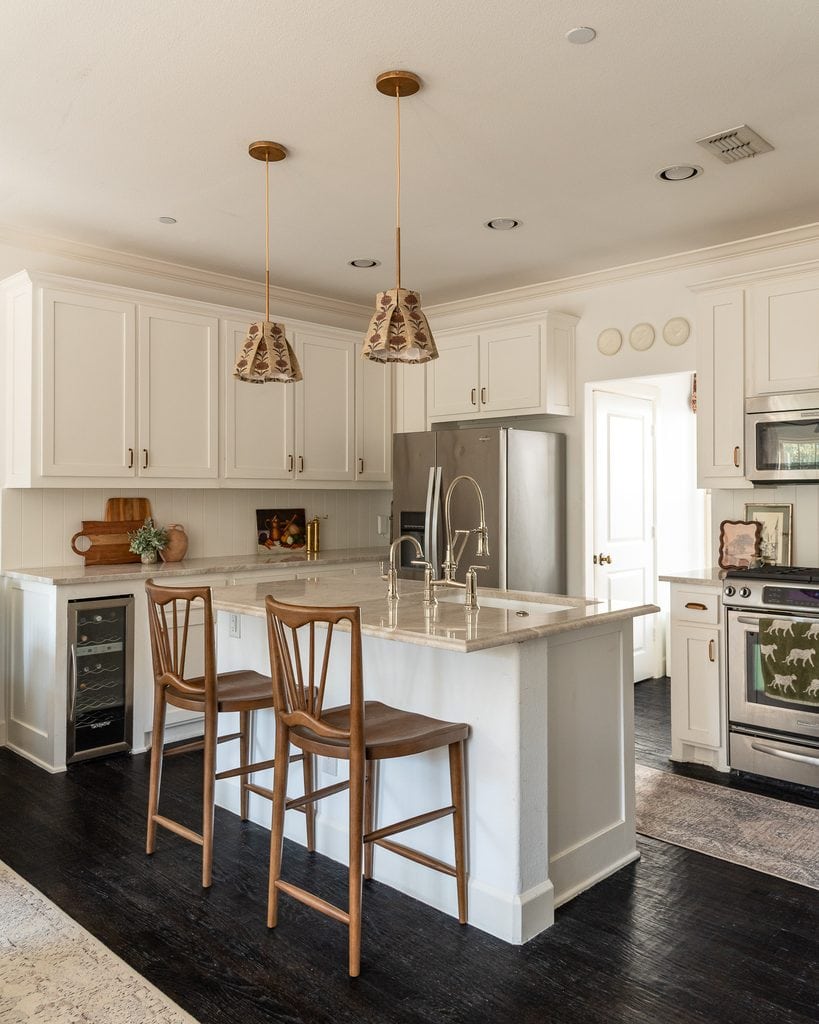
We installed this 32-inch white fireclay sink as an undermount. It cost $286.86 and included the bottom grid and strainer. It was the best deal I found for the size and material—and, very importantly to me, it did not have an ugly visible logo.
The sink sits in our island. Its outer rim is approximately 32 inches, with an interior basin around 29 inches, and it fit within our 32.25-inch sink cabinet (yes, it’s a tight squeeze… thankfully it’s from Home Depot which means I could easily return it if need be!). Because fireclay dimensions can vary, I had the sink physically on site for our fabricator to measure before he cut the slab.
Faucet and Sink Fittings

I splurged on the faucet and related polished-nickel sink fittings, which totaled $2,337.27 including tax. The star is the Brizo Rook bridge faucet in Brilliance Polished Nickel, and I am obsessed with it.
I chose polished nickel instead of unlacquered brass (it was a huge internal debate!) because the unlacquered brass bridge faucets I was looking at did not explicitly have matching reverse-osmosis water filter dispensers unless I went up a lot in price. Meanwhile, the Brizo Rook has a gorgeous matching RO-compatible cold water dispenser.
Another reason I chose this particular bridge design was because I didn’t want another separate side-sprayer hole cluttering the island sink. The sprayer is incorporated into the faucet, which meant I only needed a two-hole installation. With natural stone, every opening is permanent, so I wanted the sink area to feel deliberate rather than like a row of unrelated holes and accessories.
Polished nickel is also a beautiful partner for Taj Mahal. It has a warmer cast than chrome, so it relates naturally to the cream and taupe in the stone, but it still reflects light and feels more nuanced than bright brass would in our kitchen. It also doesn’t visually stand out as much as brass would.
Wood Counter Stools

I chose these counter stools because their warm wood complements the creamy Taj Mahal quartzite and adds natural texture beside our v-groove backsplash. I’m honestly obsessed with them!
They are extremely high-quality and are incredibly kid-friendly: there is no upholstery to stain, the wood wipes clean easily, and the solid construction feels substantial. Each stool arrived fully assembled in one piece, and there are no visible screws on the back to interrupt the clean, sculptural design.
They give me the elevated look I wanted without being remotely precious around two young children.
Living With Polished Taj Mahal Quartzite

My honest short-term review is that I love the polished finish and have no regrets about selecting it. It brings out the crystalline depth of our slab, and the reflection is an advantage in our darker kitchen. I would choose this exact overall look again.
I was not given clear information about whether our slab was sealed before or during installation, nor was I given a specific resealing schedule. Rather than inventing one, my advice is to ask your fabricator these questions:
- Was the slab sealed, and if so, with which product?
- Was it sealed before fabrication, after fabrication, or after installation?
- When should this particular stone and finish be tested again?
- Which daily cleaner do you recommend?
- Does the sealer or installation carry a stain warranty?
According to the Natural Stone Institute’s quartzite care guidance, darkening around the sink when the stone gets wet can indicate that the surface needs sealing or that the existing sealer is becoming less effective. Their general natural-stone guidance recommends a damp cloth, mild soap or a pH-neutral stone cleaner, and prompt spill cleanup.
A sealer helps reduce absorption and staining; it does not turn natural stone into an indestructible coating. I still use cutting boards and trivets, clean spills promptly, and avoid harsh or acidic cleaning products unless the fabricator has confirmed they are appropriate for the exact stone.
And I will continue updating this post as we live with the countertop longer. I would rather give a truthful timeline than present a few months of ownership as a ten-year durability test!
The Imperfection I Wish I Had Caught
Natural stone is supposed to contain variation, but there is a difference between embracing nature and failing to inspect the slab closely enough. Our installed countertop has one small area that appears to have been filled. Here is a close-up photo of it, and it is exactly the kind of detail that is easy to miss when you are taking in an entire slab at once.

It doesn’t make me regret the countertop at all, of course, but it does serve as a lesson I can share with others: inspect every part of your slab and explicitly tell the fabricator which areas you want to avoid. Ask to participate in the layout if possible. A filled spot that seems tiny on a full slab may feel much more prominent if it lands in the middle of an island. Fortunately, ours is off to the side of the kitchen island, and is not very noticeable.
Taj Mahal Quartzite Pros and Cons
| Pros | Cons |
|
|
Is Taj Mahal Quartzite Outdated?
No, I do not think Taj Mahal quartzite is outdated—but it is undeniably popular. Those are not the same thing. A natural cream stone with restrained movement can work across many design periods. However, an entire formula can become associated with a particular era, especially when Taj Mahal is paired with pale white oak, creamy cabinetry, handmade tile, and brass in exactly the same way as every other kitchen.
I think the quieter slabs have the best chance of aging gracefully because they behave like a supporting material instead of a giant pattern. The most dramatic, strongly caramel, or heavily veined versions may be easier to date later.
The surrounding choices also matter. In our kitchen, the dark existing floors, polished nickel plumbing, softened ogee island edge, vertical backsplash, and eventual layered cabinet colors create a more personal combination. The stone participates in the room; it is not the room’s entire personality.
Trends are useful information, but they should not override your reaction to a permanent material. I knew Taj Mahal was popular when I chose it. I also knew it gave our kitchen exactly the warmth, lightness, and natural variation I wanted.
But I would rather choose a popular material I genuinely love than a rarer slab that is technically more unique but wrong for our home!
Would I Choose Taj Mahal Quartzite Again?

Yes—without hesitation. I would choose Taj Mahal quartzite again, and I would choose the quiet, creamy slab again too. It transformed our kitchen more than I expected. The room feels brighter and visually larger, but it still feels warm enough to belong with our dark floors and collected home.
My only real change would be procedural: I would scrutinize the slab even more closely and participate more explicitly in deciding which areas were used. The small filled imperfection taught me that “natural stone varies” should not be treated as a reason to skip detailed layout conversations.
If you are deciding between several Taj Mahal slabs, my advice is not to choose the most exciting slab at the warehouse automatically. Choose the slab that creates the best room. For us, the simplest, creamiest Taj Mahal was absolutely the right decision.
Taj Mahal Quartzite Kitchen FAQs
Is Taj Mahal quartzite actually quartzite?
Taj Mahal is sold as quartzite, but natural-stone trade names are not always geologically consistent. Ask about the exact slab and consider scratch and acid testing before fabrication. True quartzite should resist ordinary household acids and scratching better than marble.
What is the difference between Taj Mahal quartz and quartzite?
Taj Mahal quartzite is natural quarried stone, while Taj Mahal-look quartz is an engineered material made with mineral particles, resin, and pigments. Quartz offers more consistent patterning and generally doesn’t require sealing, while quartzite provides one-of-a-kind natural depth and greater heat resistance. Product-specific care requirements still apply to both—but the designer in me will tell you to choose natural quartzite whenever possible!
Does Taj Mahal quartzite stain, etch, or need to be sealed?
True quartzite should not etch from ordinary kitchen acids the way marble does, but it can absorb liquids and stain if the stone is porous or inadequately sealed. Many quartzite countertops benefit from an impregnating sealer, although there is no universal resealing schedule for every slab. Ask your fabricator whether your countertop was sealed, wipe up spills promptly, and watch for water darkening the stone—especially around the sink.
Final Thoughts on Our Taj Mahal Quartzite Kitchen

Choosing Taj Mahal quartzite is only the beginning—the exact slab, finish, layout, and surrounding colors determine the final result. For our small, low-light kitchen, the quietest, creamiest slab added natural depth without adding heaviness.
My biggest advice is to view the full slab, inspect it carefully, discuss the layout before fabrication, and compare complete quotes. Choose the slab that makes your entire kitchen better—not simply the most dramatic one at the slab yard.
Happy countertop choosing!
Jasmine